
If you’ve spent much time reading about Hawaii, there’s a good chance you’ve encountered the name Pele.
She’s often introduced simply as the Hawaiian goddess of fire and volcanoes.
But that’s only the beginning.
In Hawaiian tradition, Pele is intimately connected with the volcanic forces that created and continue to reshape the islands. She can destroy land, but she also creates it. That combination of destruction and creation is one of the things that makes her story so fascinating. National Park Service
And once you know a little about Pele, it’s difficult to look at Hawaii’s volcanic landscape quite the same way again.
Pele’s Journey to Hawaii
According to Hawaiian moʻolelo, or traditional stories, Pele came from a distant homeland known as Kahiki.
Her journey eventually carried her southeast through the Hawaiian Islands as she searched for a place where her fire could remain. She ultimately made her home at Halemaʻumaʻu crater at the summit of Kīlauea on the Island of Hawaiʻi. National Park Service
There’s something especially interesting about the path of Pele’s legendary journey.
It mirrors the geological progression of the Hawaiian Islands, with the older islands lying to the northwest and younger volcanic activity occurring farther southeast. The National Park Service even uses Pele’s journey as a way to explore the relationship between traditional Hawaiian stories and the geological formation of the islands. National Park Service
It’s a wonderful example of what I love about learning the stories of a destination.
Suddenly, the landscape has another layer.
Pele Is Both Creator and Destroyer
We tend to think of volcanoes primarily as destructive.
Lava can consume roads, homes, forests, and everything else in its path.
Pele certainly represents that power.
But Hawaiian tradition also recognizes something else.
Lava creates.
As molten lava reaches the surface and eventually cools, it creates new land. Even today, volcanic activity continues the process that built the Hawaiian Islands over immense spans of time. National Park Service
That makes Pele both a destructive and creative force.
She takes away.
And she builds something new.
I think that duality makes her much more interesting than simply calling her a “fire goddess.”
Then There Is Hiʻiaka
Pele’s stories don’t exist in isolation.
One of the best-known Hawaiian moʻolelo involves Pele and her youngest and beloved sister, Hiʻiaka.
The story begins when Pele sends Hiʻiaka to Kauaʻi to retrieve Pele’s lover, Lohiʻau.
What follows is anything but a simple errand.
Hiʻiaka discovers Lohiʻau has died, restores him to life, and begins the journey back toward Pele. Meanwhile, Pele becomes suspicious that her sister has betrayed her. In her anger, she destroys Hiʻiaka’s beloved ʻōhiʻa groves and her friend Hōpoe.
The conflict eventually erupts into a confrontation at Kīlauea, with jealousy, revenge, destruction, and ultimately reconciliation woven into the story. National Park Service
If that sounds dramatic, it is.
The stories of the Hawaiian gods aren’t tidy little descriptions of who controlled fire, water, or agriculture.
They are stories, filled with relationships, rivalries, loyalty, anger, love, and consequences.
That’s what makes exploring them so much fun.
Kīlauea Is More Than a Volcano
If you visit Hawaiʻi Volcanoes National Park, you’re entering a place with tremendous geological importance.
You’re also entering a culturally significant landscape.
Halemaʻumaʻu is traditionally regarded as Pele’s home, and the Kīlauea summit area appears throughout Hawaiian chants and oral histories. For some Native Hawaiians, Pele is regarded as ʻohana, or family, and as an ʻaumakua, a family or deified ancestor. National Park Service
That matters when we visit.
It’s easy as travelers to see an incredible landscape and think only about photographs, hiking trails, viewpoints, and whether lava happens to be visible.
But we’re visiting somewhere that may hold meanings very different from our own.
Knowing that doesn’t diminish the experience.
It makes the experience richer.
The Stories Aren’t Frozen in One Version
There’s something else worth understanding about Hawaiian moʻolelo.
You may encounter different versions of the same story.
That’s not necessarily because someone got it wrong.
These stories were passed through oral traditions over long periods of time, and versions can differ, sometimes significantly. The National Park Service specifically notes this when presenting moʻolelo connected with Pele and Hawaiʻi Volcanoes National Park. National Park Service
I actually think that makes exploring them even more interesting.
You’re not reading a single modern story with one definitive text.
You’re encountering traditions carried across generations.
Why Learn About Pele Before Visiting Hawaii?
Because knowing the stories changes what you notice.
If you visit Kīlauea knowing nothing about Pele, you can still stand there and be amazed by the geology.
You should be.
It’s extraordinary.
But if you know the traditional stories too, you’re seeing another dimension of the same place.
Science can explain how volcanic activity built the Hawaiian Islands.
Moʻolelo can help us understand how generations of Hawaiians interpreted, remembered, and related to those forces.
Those perspectives don’t have to compete.
Together, they make the place far more interesting.
Pele Is Only the Beginning
Pele may be one of the best-known figures in Hawaiian tradition, but she belongs to a much larger world of gods, goddesses, legendary figures, and stories.
And that’s exactly why I wanted to write Hawaiian Gods.
Once I started looking beyond the names and into the stories themselves, Hawaii became even more fascinating to me.
The volcanoes.
The ocean.
The forests.
The winds.
The land.
There were stories everywhere.
Final Thoughts
Pele is often introduced in one sentence:
The Hawaiian goddess of fire and volcanoes.
That’s true, but it doesn’t begin to capture everything surrounding her.
She’s a traveler searching for a home.
A sister.
A lover.
A force capable of tremendous destruction.
And a creator whose lava builds new land.
Most importantly, Pele is part of a living Hawaiian cultural tradition deserving respect, not simply a character from an old legend.
The next time you look across the volcanic landscape of the Island of Hawaiʻi, you may see the geology.
But now you’ll know there’s another story there too.
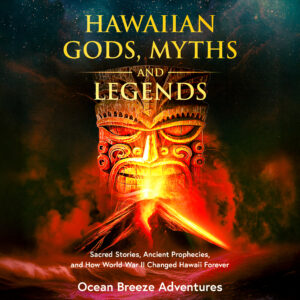
And if you’d like to discover more of those stories, my new book Hawaiian Gods is available now.
And the ebook is free. 🌺
Mahalo,
Diana
Ocean Breeze Adventures